
Burlington County Address History by Record Era
Previous residents research changes tools as the date moves. Burlington County's modern recorded-document route is the Clerk's PRESS system, but its available fields change at 2012 and 1965. For older property history, the County archive viewer and the State Archives deed collection take over. Directories, census schedules, newspapers, and probate records add the household layer. The table separates what each source can establish from what it cannot, so a recorded owner is not casually relabeled as a person who lived at the address.
| Source | Years it covers | Where held | What it shows |
|---|---|---|---|
| PRESS block/lot and name search | 2012-03-01 to current for block/lot and name; 1965-2012 name only | Burlington County Clerk | Recorded instruments, parties, and images where available. |
| County pre-1965 archive | Before 1965 | County archive viewer | Older property-image and owner-name route. |
| Burlington deed books and indexes | Deeds 1785-1901; indexes 1785-1921 and 1948 | New Jersey State Archives | Conveyances, grantor/grantee names, and legal descriptions. |
| FamilySearch county deeds | County deeds through 1900, availability varies | FamilySearch | Digitized deed-book images or indexes. |
| Criss-cross directories | 1971-1995; gaps in 1975, 1984, 1993, and 1996 | Library of Congress inventory and local collections | Address-to-name clues, often in street sequence. |
| Named local directories | Selected 1868-69, 1881-1913, 1926, 1929, 1945, and 1955-56 runs | State Library inventory, BCLS, and Historical Society | Addresses, households, businesses, and rural-route context. |
| Federal census | 1790-1950 under the 72-year release rule | Archives and genealogy databases | Household, age, relationship, birthplace, and address or geography. |
| New Jersey state census | 1855-1915 | New Jersey State Archives | State enumeration details. |
| Municipal construction permits | Range not printed in the research | Construction office | Building, alteration, inspection, or address chronology. |
| Newspapers and obituaries | Central Record 1975-2021; full text from 2001, plus older indexes | BCLS and local collections | Death, moves, property notices, kin, and civic activity. |
For a recent transfer, begin with the parcel and the recorded deed. For a late twentieth-century address, add the criss-cross run. For an older parcel, the county archive and State Archives deeds are the stronger route. An address is a thread between these sources, not proof that every name appearing in one source belonged to the same household.
Pin a Burlington County Address to Its Parcel
Before tracing past residents, normalize the current street number and name, legal municipality, ZIP, and any known earlier name. NJGIN address points, alternate street names, municipal maps, and the municipal assessor help turn that address into a municipality, block, lot, lot qualifier, or PIN. The assessment record distinguishes situs, the physical parcel location, from the mailing address where tax notices go. A mailing address can be a useful lead, but it is not proof that a person lived at the parcel.
Use the legal description as the stable check when a street label changes. A lot-and-block reference, subdivision reference, or metes-and-bounds description can follow the parcel even when a postal name, road label, or numbering convention changes. Record the municipality and source year beside the key. Burlington County's forty municipalities have separate local custodians, and a postal city can cross those legal lines.
Note: A consistent legal description across a deed, assessor card, and map is stronger than a repeated surname or a matching delivery label.
Burlington County PRESS Cutoffs for Older Addresses
The County Clerk's Public Records Electronic Search System, known as PRESS, has four search modes: instrument number, document type, block and lot, and name. Documents recorded on or after March 1, 2012 can be searched by municipality, block and lot, or property owner. The period from 1965 through February 2012 is owner-name-only. Before 1965, PRESS directs researchers to the county archive viewer, also using owner-name searching. Maps recorded before 1995 are not on PRESS.
Those limits are a key Burlington County numbers story. A block-and-lot search that works for a recent deed will not recover an older document by itself. At the 1965 break, preserve the party name, date, instrument or book-and-page reference, and legal description, then change to the name route. The Clerk's PRESS name mode accepts a last or company name and an optional first name; it also supports the percent sign as a wildcard for surname variation.
The County pre-1965 archive viewer is the first older-image fallback linked from PRESS.
The archive route preserves the older-record transition without pretending that the modern PRESS screen has the same address-search capability for every decade.
Follow Burlington County's Previous Ownership Chain
Once the parcel and current recorded party are known, a chain of title can be walked backward through the purchase deed. Start with the current party and locate the instrument in PRESS using block and lot where the period permits, or the recorded name where it does not. Open the document-type result and save the instrument number or book and page, recording date, parties, municipality, legal description, and image link. The seller or grantor on that acquisition becomes the next name to investigate as an earlier grantee or recorded party.
- Confirm the current parcel's municipality, block, lot, and legal description through NJGIN or the municipal assessor.
- Find the purchase deed in PRESS and record the instrument or book-and-page reference, parties, date, and legal description.
- Search the seller from that deed as an earlier recorded party, checking initials, spacing, hyphens, trusts, and business names where the index warrants it.
- Repeat the transfer sequence backward, preserving the evidence that ties each party to the same legal description.
- At the older index boundary, move to the archive viewer, then to State Archives or FamilySearch deed books rather than guessing from a surname match.
- Grantor and grantee
- The grantor transfers an interest in a recorded document. The grantee receives that interest.
- Chain of title
- A documented sequence of recorded transfers tied to the same parcel or legal description.
- Legal description
- The formal parcel description in a record. It often outlasts a street-name or numbering change.
- Situs
- The physical parcel location, which may differ from the address used for tax mail.
A deed establishes a recorded property interest. It does not, by itself, establish who lived at the property in that period.
Burlington County's 1785 Deed-Book Trail
The older end of a Burlington County address history is unusually well defined. The State Archives guide identifies deeds from 1785 through 1901, indexes from 1785 through 1921 and 1948, and 198 microfilm reels. Original Book A begins in 1785. The Archives also says county deeds through 1900 are on microfilm and digitized through FamilySearch, though the exact current collection availability can vary by account or location.
This record chain reflects a much older county practice. The County Clerk traces public deed recording to West Jersey's 1676 Concessions and Agreements and cites the 1799 conveyance act requiring preserved county books for deeds and conveyances. The cataloged 1785 boundary is a collection fact, not proof that no earlier local land evidence exists. Keep the book, page, reel, date, and exact party spelling so a later researcher can retrace the link.
The New Jersey State Archives genealogy search is the official entry point for this historic layer.
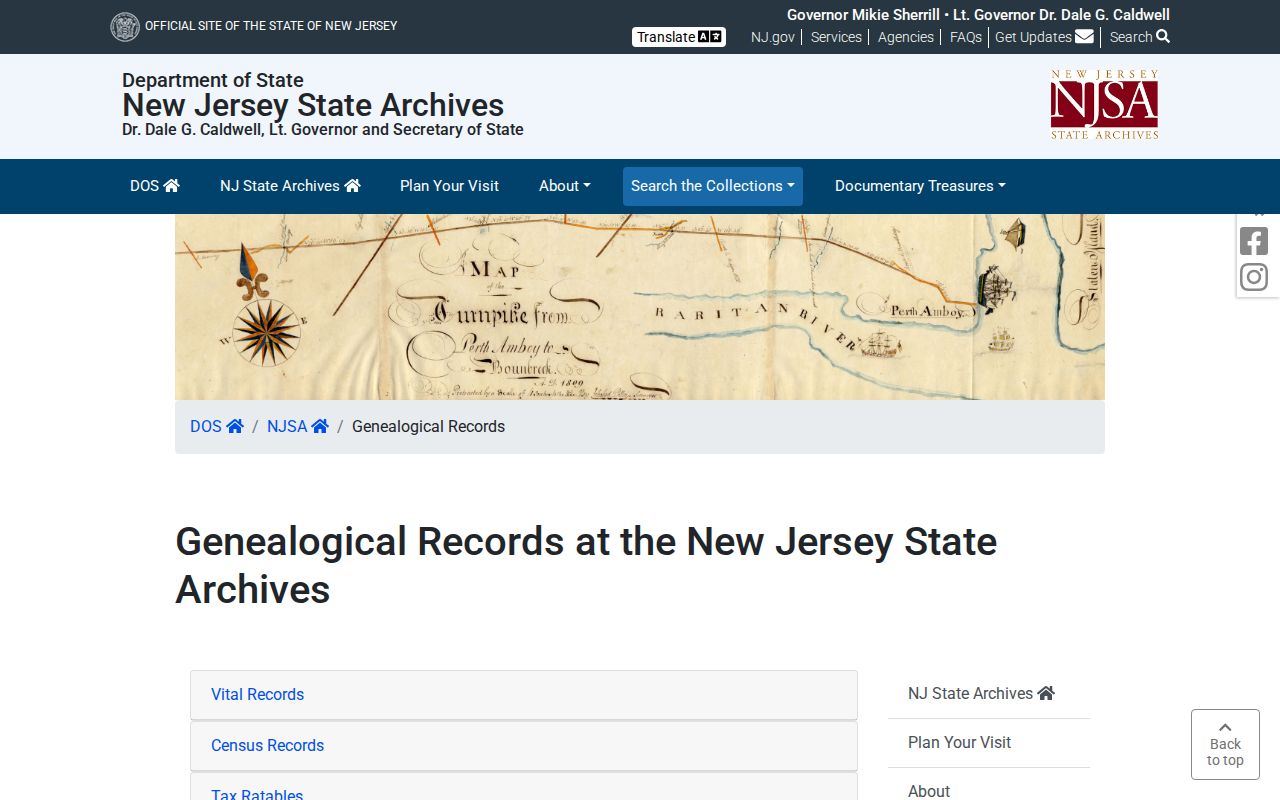
The Archives route adds deeds, censuses, naturalizations, road records, newspapers, and surrogate material when the county's current portal no longer reaches the right era.
Burlington County Criss-Cross Years for Past Residents
A deed chain follows recorded ownership. A criss-cross directory supplies a different sort of clue by arranging names through addresses or street sequence. The Library of Congress inventory identifies a Burlington County, New Jersey run from 1971 through 1995, with cataloged gaps in 1975, 1984, 1993, and 1996. Its street-address inventory separately lists Burlington, New Jersey for 1970-1971, and that listing should not be stretched into a countywide run.
Use a dated street section to test who lived at an address around a known year. Record the exact printed spelling, the address, the year, page, and any abbreviation key. An absence is only a lead: publisher coverage, a rural route, a renamed street, an address change, surname variation, or a catalog gap can all produce a false disappearance. For the collections themselves and their publishers, see the Burlington County city directory.
The Library of Congress street-address inventory shows the separate address-directory category used for this stage.
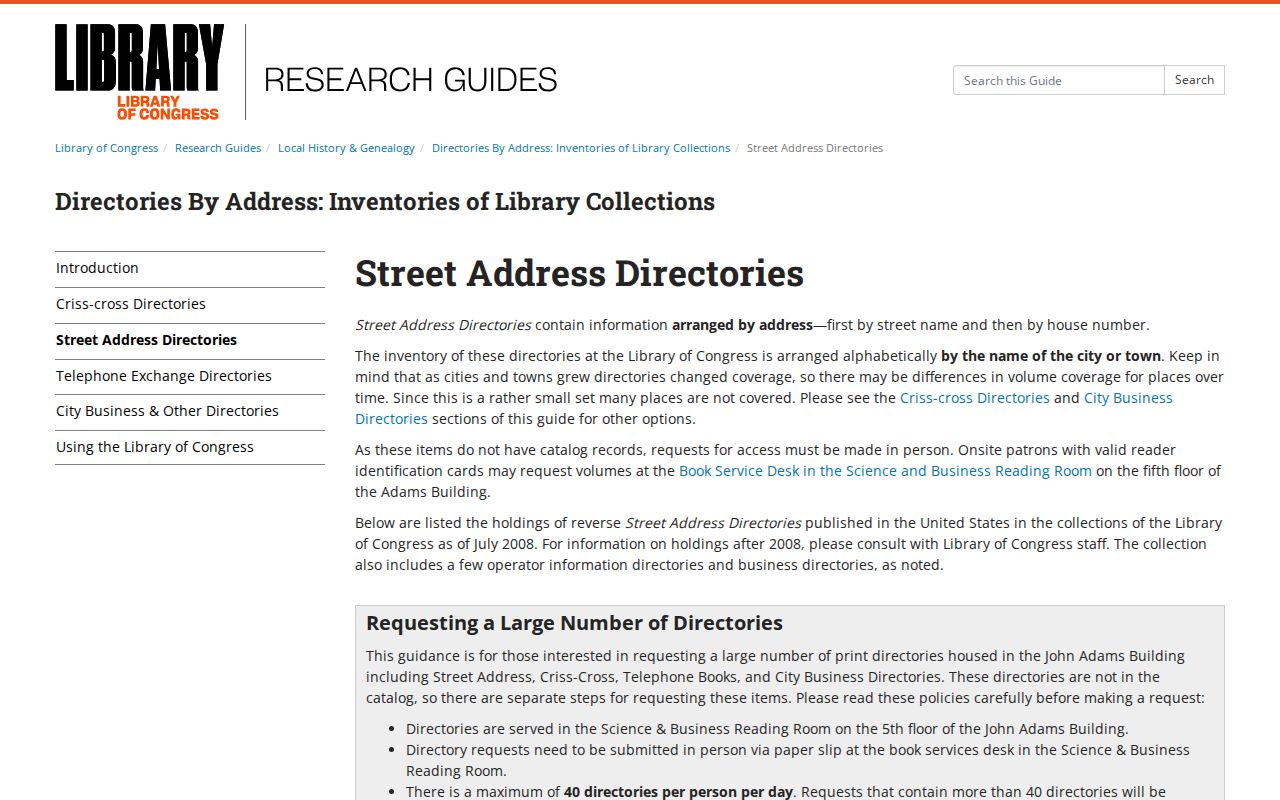
A catalog entry tells researchers where a directory type and year are described; it does not mean the Library will search names or that every year is complete.
Past Burlington County Households Across Directory and Census Years
Past residents are best tested through dates. Begin with the closest available directory entry, copying the spelling, initials, spouse or widow notation, address, and any role or business detail exactly as printed. Check a street or criss-cross section when one exists. Then compare adjacent directory years for a move, death, address change, or a different household pattern. Federal census material is available through the 72-year release rule, while New Jersey state census schedules cover 1855 through 1915.
- Place the directory or criss-cross entry on a dated timeline for the address.
- Pair it with the nearest available federal census or New Jersey state census schedule.
- Compare the address or geography, names, relationships, and any matching spouse or occupation clue.
- Use the deed and assessor sequence to distinguish a recorded party from a dated directory or census entry.
- Check a newspaper notice, cemetery record, or probate file when a death, move, or estate transfer may explain the change.
BCLS maintains local-history materials including family files, cemetery records, scrapbooks, city directories, maps, newspapers, photographs, and historical indexes. The Central Record has a 1975-2021 publication history and full text from 2001, while older notices often lead through an index, microfilm, or library request. A dated directory entry is historical evidence, not a current address claim.
Burlington County Road Records and Address Continuity
When the number or street name stops making sense, use records that describe the road itself. Burlington County road records held by the State Archives cover 1762 through 1950 in Books A through E on three reels. Municipal historic, zoning, voting, and neighborhood maps, plats, directory street sections, and a deed's legal description can bridge a former road name or an unclear route description. No specific countywide street-renumbering year was verified, so a break in the address trail should remain a research question rather than a made-up event.
The county's geography explains why this work matters. River towns may have compact historic blocks, while rural and Pinelands communities can use long routes and postal names that differ from the legal municipality. A house history is stronger when a map, a directory, and a deed agree on the same place and period. A repeated address-looking phrase in one source is not enough when the jurisdiction or date changes.
The Burlington County history page supplies the local context for the county's distinct river, suburban, and rural records geography.
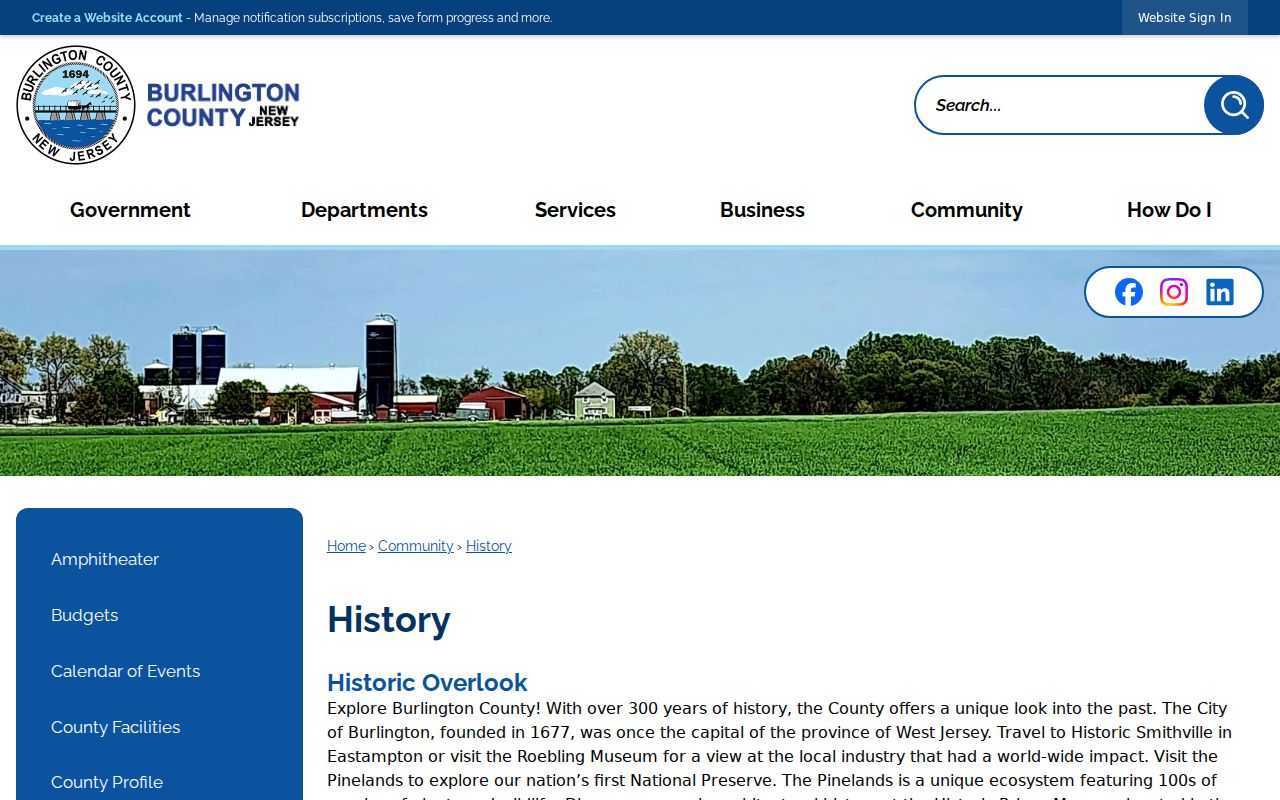
Historic context can help choose a map or directory era, but it never replaces the parcel evidence that ties a record to one address.
Burlington County Research Rooms for Past Households
The Burlington County Library System's New Jersey Room is the practical local starting point when an online index reaches a gap. Ancestry Library Edition is available in the library, HeritageQuest is available with a library card, and BCLS also provides local newspaper indexes and historical images. The confirmed New Jersey Room materials include directories, maps, family files, cemetery records, scrapbooks, newspapers, and photographs. Ask for the municipality, street, year range, and record type rather than a generalized resident list.
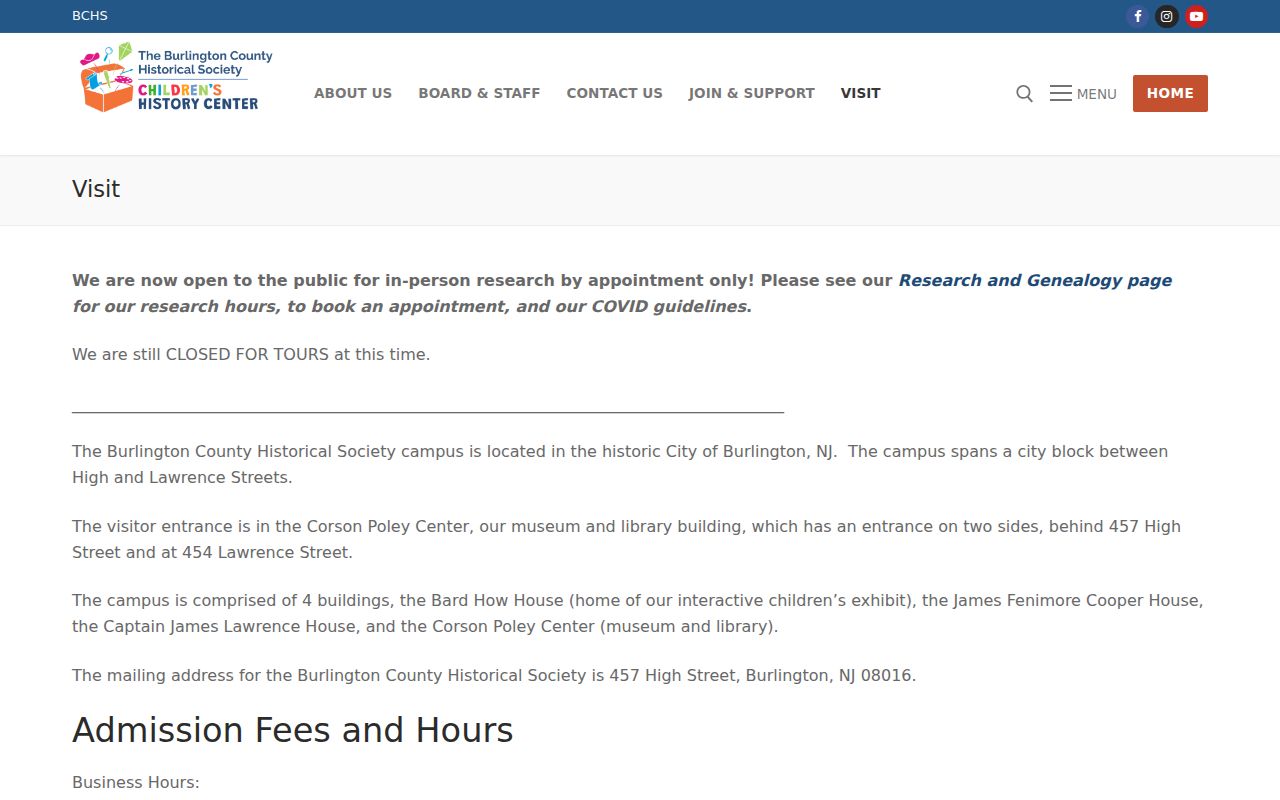
The Burlington County Historical Society at 457 High Street in Burlington holds deeds, maps, manuscripts, family albums, marriage certificates, business records, rare books, and photographs. Its library research is by appointment; the visit information lists a $5 research fee and Tuesday through Saturday hours from 10 a.m. to 5 p.m. The research did not locate a dedicated county house-history guide, so these are confirmed collection paths, not an assertion that staff will perform a particular service.
The Historical Society visit and research information gives the appointment-based alternative to online searching.
Local collections can connect a property clue to maps, family material, photographs, or newspapers, while the Clerk and Archives remain the custodians for the legal-record trail.
Burlington County Probate Trail Endpoints
An obituary or probate record can close part of a past-resident trail without proving a current location. The Burlington County Surrogate's live index searches last name, first name, docket number, city, and death date. Its visible result columns include ID, name, last name, first name, suffix, docket number, city, and death date. The index warns that it is incomplete, may lag 24 hours or more, and is not a filing or notice. Record searches are appointment-based.
Use a death date or city from an obituary as a cross-check, then ask the Surrogate about the underlying file and what is releasable. Probate material can provide an executor or next-of-kin lead, and a later deed may show an estate-related transfer. Neither source should be used to infer a living person's present address. The strongest endpoint is a dated, cited record that fits the deed and directory sequence.
Burlington County Address-History Limits
Public records are separate systems with separate privacy rules. Daniel's Law can redact covered people from government sites, the Address Confidentiality Program supplies a legal substitute address for eligible participants, and court, vital, or other restricted records may not be open. A missing name can also result from an incomplete index, a directory gap, a changed name, or an address that was never recorded in the source. Absence does not establish that someone did not live at a place.
New Jersey's stalking statute is N.J.S.A. 2C:12-10, and its harassment provisions appear in N.J.S.A. 2C:33-4. Preserve the document date, source URL, instrument or page reference, and exact indexed spelling. If an official record appears wrong, ask the custodian that created it about correction rather than changing the conclusion to fit a preferred story.