
Burlington County Directory Holdings
The strongest starting point is the New Jersey State Library's directory inventory, which records specific Burlington County titles, years, publishers, and reel or book holdings. It is an inventory, not a guarantee that every year survives or is digitized. That distinction matters here because early titles cover selected river towns and later titles add or omit places. A surname absent from one book may reflect its scope, a rural route, a publisher's survey, or a missing year rather than a family move.
| Directory collection | Documented years | Where listed or held | Access route |
|---|---|---|---|
| Bordentown, Burlington & Mt. Holly Directory | 1868-69 | State Library inventory; Camden County Historical Society reel 49 | Catalog and collection inquiry |
| Boyd and Howe Burlington County directories | 1881-82 through 1910-11, selected runs | State Library inventory, Burlington Segments III and IV reels | Reel or book research |
| Farm Journal Farm Directory | 1913 | Camden County Historical Society reel 49 | Farm and landowner context |
| Manning river-town directories | May 1926 and May 1929 | Cataloged books | Physical-volume inquiry |
| Calkin-Kelly and Clark Burlington directories | 1945; 1955-56 | Cataloged book and historical-society reel holdings | Book or reel research |
| Burlington County criss-cross directories | 1971-1995, with gaps | Library of Congress inventory | Catalog request by exact year |
The titles also explain why these historical books need care in Burlington County. The 1868-69 volume joins Bordentown, Burlington, and Mount Holly. Some Boyd and Howe editions add places such as Beverly, Moorestown, or Riverside. The 1913 Farm Journal volume is a farm and landowner source rather than a city-only list. Record the title as well as the year before drawing a conclusion about who a volume was designed to cover.
Note: A cataloged run identifies a research lead, not a promise that every household or every municipality appears in each volume.
Burlington County Directory Eras
The cataloged sequence has a clear local shape. J. H. Lant's 1868-69 three-town directory is the earliest documented starting point in the inventory. Boyd and Howe county titles follow across selected years from 1881-82 through 1910-11. Manning's May editions then focus on a cluster of river communities, and the 1945 Calkin-Kelly and 1955-56 Clark volumes provide later Burlington-focused snapshots. That progression is useful history, but it does not establish a first or final directory year for the whole county.
- 1868-69: J. H. Lant & Co. listed Bordentown, Burlington, and Mount Holly.
- 1881-1910: Boyd and Howe titles moved through county editions, with town coverage changing by volume.
- 1913: The Farm Journal directory adds a separate agricultural and landowner layer.
- 1926 and 1929: Manning volumes identify Burlington-area river towns, with Mount Holly and Moorestown added in the later title.
- 1945 and 1955-56: Calkin-Kelly and Clark volumes provide later city-focused coverage, including rural-route context in the Clark title.
Burlington County's history makes the uneven geographic reach unsurprising. Burlington City was founded in 1677 and had an early West Jersey political role, while Mount Holly developed as the county-seat center. River towns, suburban communities, and Pinelands townships did not share one publishing market. A directory year should therefore be read as the publisher's chosen service area, not as a countywide census.
Burlington County Directory Research Rooms
The Burlington County Library System's Local History and Genealogy resources make the New Jersey Room a practical first stop when a digital search stalls. The library identifies historical directories alongside family files, cemetery records, scrapbooks, maps, newspapers, and photographs. Its research tools also include Ancestry Library Edition for in-library use, HeritageQuest through library-card access, and the Central Record of Medford through NewsBank. Access mode matters, especially for a researcher who cannot visit in person.
The library's local-history page shows the resources that sit beside a Burlington County historical-directory search.
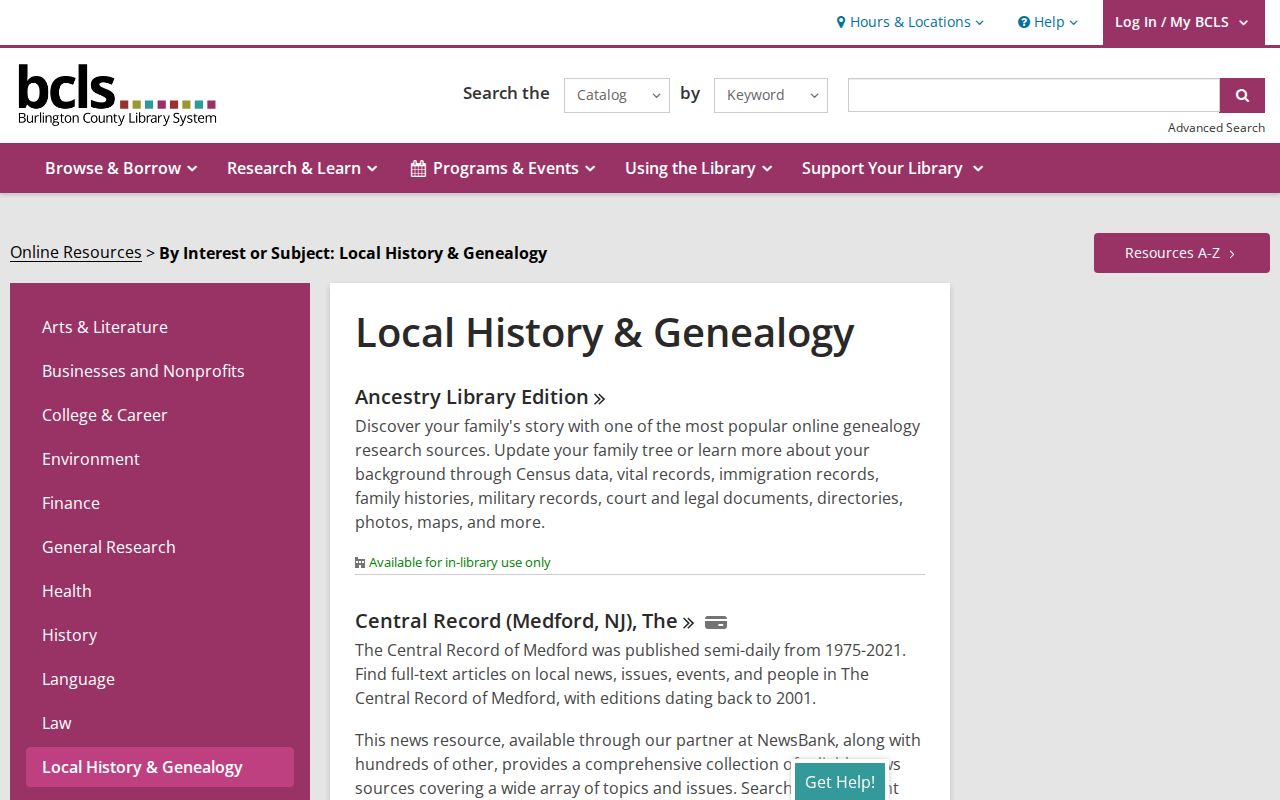
Use those companion sources to test a directory spelling, locate an obituary citation, or identify a street before ordering a copy.
A BCLS New Jersey Room research article also describes the library's genealogy starting points. Begin with the title and year that fit the town, then ask staff whether a physical directory, microfilm, family file, or newspaper index fills the gap. A library citation is often more useful than a bare name hit because it preserves the date and publication context.
The BCLS research article is a useful reminder that city directories work best with the library's wider local collection.
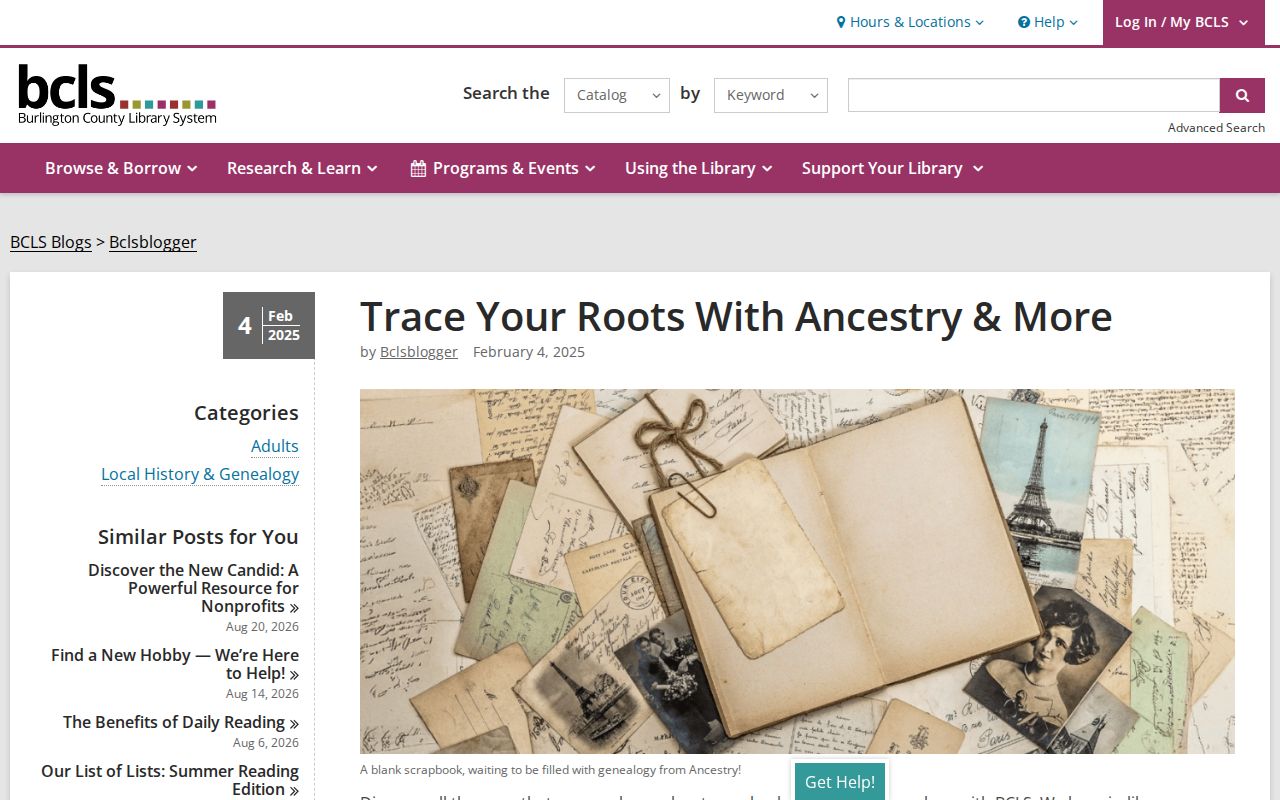
That broader shelf helps distinguish a one-year directory entry from a longer family, street, or community trail.
Reading Burlington County Listings
A Burlington County city directory entry is a compact publisher record. The Library of Congress directory guidance identifies the kinds of details that may appear: surname and given name, spouse or widow notation, occupation or business, street address, telephone, municipality, and sometimes a notation about household status. Marks and abbreviations vary by publisher and year. Photograph or transcribe the key printed in the front matter before expanding an abbreviation, because an apparent letter can have a volume-specific meaning.
| Name form | Keep initials, suffixes, spacing, and surname variants exactly as printed. |
|---|---|
| Family notation | Spouse, widow, or household wording can guide a later newspaper, probate, or census search. |
| Occupation or business | Use it as a dated identity clue, not proof of an enduring affiliation. |
| Street line | Record the house number, street spelling, municipality, and year together. |
| Address marker | Retain printed symbols such as the documented h address marker and consult the volume's key. |
| Change notation | “Moved,” “removed,” or vacant wording is a lead that needs confirmation in another dated source. |
- Criss-cross directory
- An address-first directory section, useful for moving from a street location to the entry printed for that address.
- Householder index
- A name arrangement that may identify the person under whom a household was listed, rather than every person present.
- Abbreviation key
- The publisher's explanation of codes and short forms, usually near the front or back of the volume and essential for accurate transcription.
A digitized 1895 Boyd's directory view provides a way to inspect a real historical volume, but image and OCR readings need the same care. Search snippets can misread initials, punctuation, and old type. Compare the visible page image with the transcription before treating a detail as settled.
The digitized directory view shows why a page image is stronger than an OCR-only transcription for Burlington County historical research.
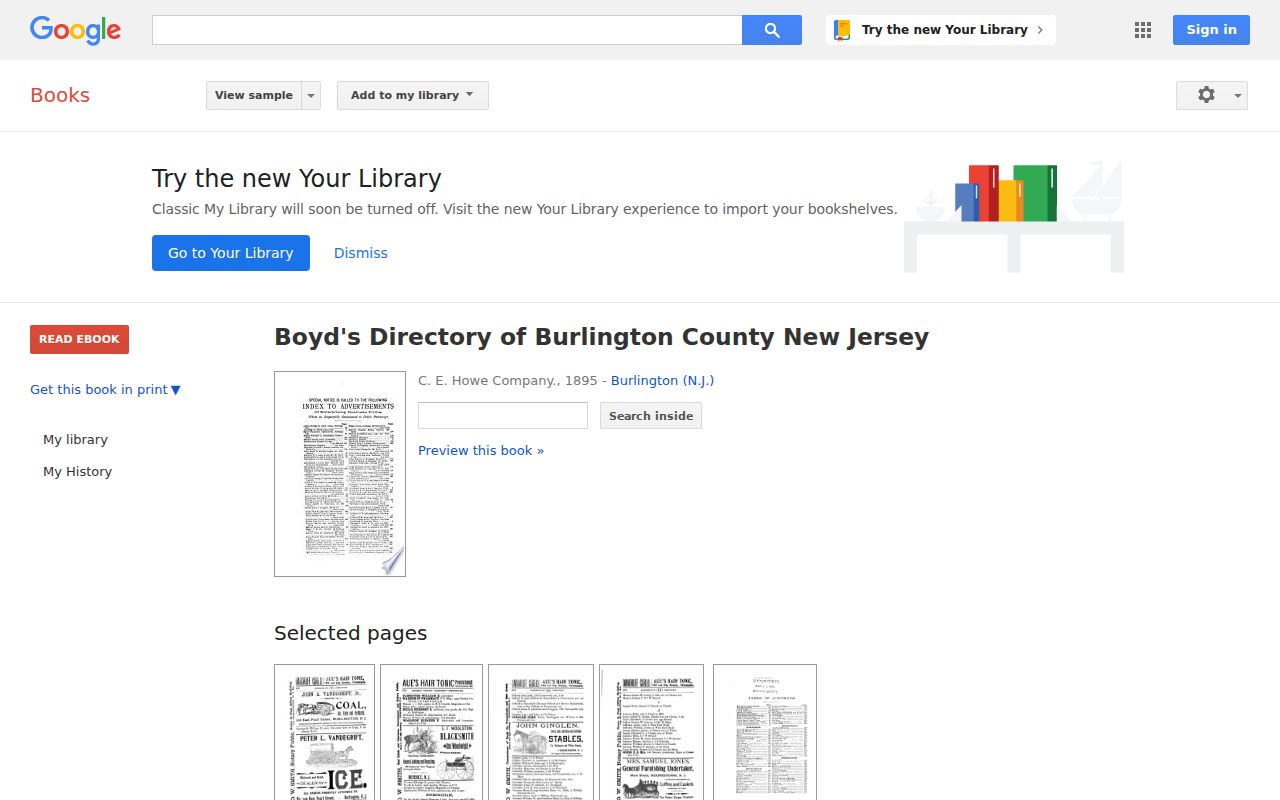
Preserving the page and entry context makes later checking against a census, deed, or newspaper citation much easier.
Burlington County Address Listings
Later criss-cross volumes give Burlington County historical research an address-to-name route. The Library of Congress catalog identifies county criss-cross coverage from 1971 through 1995, while specifically listing 1975, 1984, 1993, and 1996 as missing. Ask for the exact directory type, location, state, and year. The Library of Congress guidance notes that its cataloged collections are not interlibrary loan and that staff do not conduct name searches for requesters.
Use the street section after first confirming the legal municipality and the historical street spelling. A postal name can cross municipal lines in Burlington County, and an old address may have a different street form or route description. The criss-cross entry is historical occupancy evidence, not a present-day household list. For modern parcel and recorded-document work, use the Burlington County Street Directory route rather than rebuilding that address search from a historical volume.
Note: The documented criss-cross gaps mean that a missing address in one year should never be treated as proof of a vacancy or departure.
Tracing Burlington County Families
Work from the closest known year outward. The useful unit is not simply a name. It is a dated combination of name form, related person, address, town, and any business or occupation wording. That small record lets a researcher test whether a later appearance is the same household, a namesake, or a move between municipalities. Burlington County has 40 municipalities, so town names and postal labels deserve the same attention as surnames.
- Locate the household in the nearest available directory and copy the entry exactly, including initials and address.
- Check the preceding and following documented volumes for changes in spelling, address, spouse notation, or business wording.
- Use a criss-cross section when available to test the address and see the names printed nearby in that year.
- Pair the directory year with the relevant federal census release and New Jersey state census material from 1855 through 1915 at the State Archives.
- Use a deed, obituary, cemetery item, or Surrogate file to test a move, death, or estate connection rather than assuming why an entry disappeared.
The State Archives holds Burlington deeds, naturalizations, tax ratables, road records, censuses, newspapers, and surrogate material, while its historical series offer a way to bridge an interval between directory volumes. A directory may identify a likely address, but a recorded deed distinguishes a named party from a current owner and an obituary or probate record can date a life event. When a historical name needs a current-record confirmation, the separate Burlington County Resident Lookup process uses record-specific custodians.
Burlington County Directory News Trails
The BCLS newspaper layer can explain a change that the historical directories only hint at. The library names the Burlington County Newspaper Notices Index, Batsto Citizens Gazette, Bordentown Register and Register News, Central Record, New Jersey Mirror, and Times-Advertiser or Community News Index. Staff and volunteer citations are added daily. The Central Record of Medford ran from 1975 to 2021, with full text back to 2001 through NewsBank, while older notices often require an index, microfilm, or staff-guided request.
The Burlington County Historical Society collection is another route when a directory entry points to a deeper local story. Its holdings include deeds, maps, manuscripts, family albums, marriage certificates, business records, rare books, and photographs. Library research is by appointment at 457 High Street in Burlington, and the visit information lists a $5 research fee and Tuesday through Saturday hours from 10 a.m. to 5 p.m.
The Historical Society holdings page shows the kinds of local materials that can corroborate a Burlington County historical-directory clue.
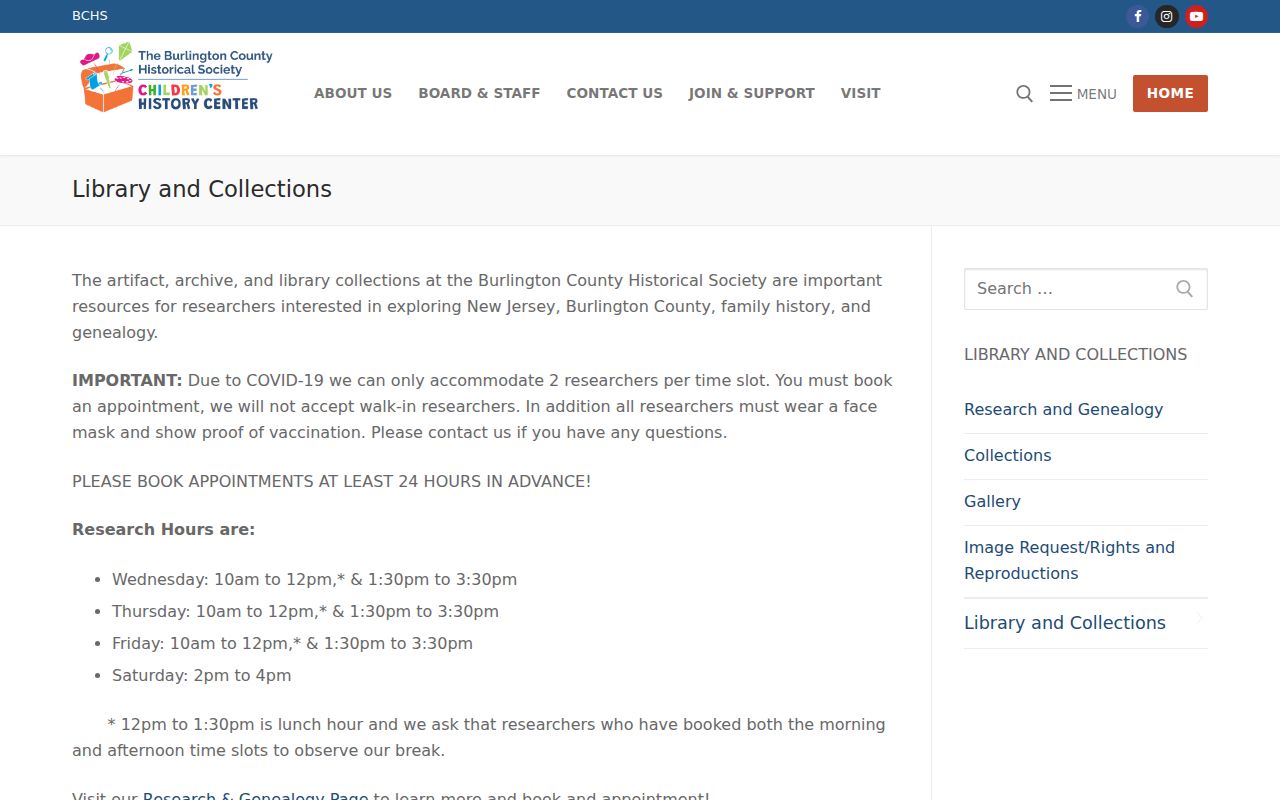
Its appointment collection is especially useful for a surname, town, street, organization, and date-range request that is too specific for a general directory search.
Burlington County Directory Coverage
The directory titles themselves show a county of different record landscapes. The 1926 Manning volume names Burlington, Beverly, Edgewater Park, Delanco, Riverside, Riverton, and Palmyra. Its 1929 successor adds Mount Holly and Moorestown. Clark's 1955-56 Burlington title reaches into part of Burlington Township, Columbus Park, Springside, Stevens Station, and rural routes. In the eastern and southern Pinelands communities, a family may be more visible in a farm directory, road record, map, newspaper, or township source than in a city-style book.
That variation is a feature of the evidence, not a failure of the search. Burlington County spans river towns, suburban corridors, and large rural areas. Use the title's stated place names to decide whether a negative result has meaning. For a rural family, the 1913 Farm Journal Farm Directory may supply landowner context that a city-style book does not. For an old street, the State Archives' Burlington County road records, covering 1762 through 1950, can help reconcile route descriptions and names.
Note: These directories are publisher surveys, so coverage, address style, and the people included can change sharply from one Burlington County volume to another.
Burlington County Directory Gaps
A directory's silence has several possible explanations. The household may have moved, used a rural route, been missed by the publisher, appeared under initials or a variant surname, or lived in a town outside the volume's advertised coverage. Missing years in the criss-cross run add another break. Record the negative search, exact title, year, and town, then test a neighboring year or another local source instead of turning an absence into a conclusion.
For material not online, start with the identified collection custodian. BCLS can provide library and database access, the Historical Society can take an appointment research request, and the State Archives offers catalog, microfilm, appointment, and research-request paths. A written request under New Jersey's Open Public Records Act belongs with the custodian of a specific existing government record, not with a library or archive for a compiled new resident list. Historical research stays strongest when each claim remains tied to its volume, page, year, and holding location.